Showing posts with label Hokkaido. Show all posts

Sunday, August 5, 2018

the hill of the Buddha, Makomanai, Sapporo

Renovated by ANDO Tadao. A large cemetery that became attractive thanks to renovation completed a few years ago. Once the Buddha statue sat alone and not effectively focused. Now people pay attention to him and the air surrounding him makes him holly. 

The whole place embodies Hokkaido; the scale is suitable for the large open land in the north of Japan.


Nearby is the outdoor art museum; a great number of sculptures. My favorite was, after all, YASUDA Kan's piece. 

by YASUDA Kan, a Hokkaido-born artist


Thursday, September 7, 2017

Motomachi walking in port town HAKODATE

Hakodate surrounded by the sea on its three sides
seen from Hakodate-yama
Hakodate became an international port along with Shimoda after the friendship treaty was struck between the Tokugawa Shogunate of Japan and the US in 1854. This ended a long-term self-imposed hibernation of this country when she enjoyed stability with limited access to things from abroad. 

Hakodate soon became one of the five treaty ports open to the five foreign countries. That was the way modern Hakodate developed.

The Motomachi district and the Bay Area are close to each other and can be enjoyed together. The whole district gives you a port city atmosphere. Japan's early modernization period when brick buildings and churches for foreign residents were built can be felt. The churches stand along with Buddhist temples and Shinto shrines.

In addition to that, Hakodate-yama hill - 334 meters high- in the same district offers a magnificent view of the city. Aerial cable service is available and it's only three minutes from the bottom to the observation building on the top.

Here are some pics from the places above.


Russian orthodox church in Motomachi

Catholic  church in Motomachi

a local hamburger shop with their chicken burger so tasty
and a convenience store famous for their lunch box with pork


Thursday, September 29, 2011

Arte Piazza Bibai


Arte Piazza Bibai is stone sculptor YASUDA Kan’s creation.

Once there stood an elementary school. Most were lost as Bibai lost its edge as a coal mining community. Fortunately, one school building and a gymnasium were saved from dismantling and now function as artistic facilities at Arte Piazza. The first floor of the former school building even serves as a kindergarten, fully rehabilitated and getting more children due to its serene, friendly and artistic environment YASUDA created.


Enjoy some of the photos taken on September 12, 2009 when I joined the day tour to Moere Numa Park and Arte Piazza.


Here you see a former school building. Schools have to be where children's heart and mind grow. Young people deserve well-designed school buildings and surroundings.


Wednesday, September 28, 2011

Isamu NOGUCHI & Moere

The rooftop of the GLASS PYRAMID

This article first written in September 2009 and compiled in September 2011


Isamu Noguchi designed the railings of the two peace bridges in the city of Hiroshima. His Japanese father worked as a professor at the university in Tokyo I graduated from. And above all, what he did was very attractive to me, especially the so-called earthworks of his. He once said, "One day I had a vision: I saw the Earth as sculpture." 

Due to these facts, Noguchi’s name has always been in my mind. So when I first came across a bit of information about Moere Numa Park, which I instantly knew I would love, I was convinced that someday I should be there. I do not exactly remember my first encounter with Moere but it should have been about ten years ago.

For many reasons, I couldn’t make it up to now but I gratefully feel that was destined that way. The grand opening of the park was in 2005. If I had been there earlier than that, I could have missed some of the works “sculpted” on the earth of the park. The time was just right and Mother Nature treated me kindly, providing the perfect weather.

Noguchi first came to Sapporo, Hokkaido on March 30, 1988. He was already at an advanced age of 83. He was shown three candidate locations suggested by the city of Sapporo for the planned grand park. One of them was a garbage dump site which the city had already started part of the transformation into a large spacious park. The city started the groundwork in 1982. Fortunately, however, when Noguchi saw the site, it was still barren and garbage was flying in the wind. No wonder because 2.7 million tons of garbage was brought in before the waste treatment plant in Moere Numa was finally closed in 1990.

In a sense, the land had not been tampered by anyone (except by the general public who produced the garbage) and it had to be infused with vision.

I believe that was much better than those already formed and shaped and nicely prepared in accordance with mediocre plans and designs.

Moere was what Noguchi showed keen interest in.

It’s never easy to give birth to any sort of things. But Noguchi was quick to come up with the ideas. In November, 1988, he presented the final master plan for the park.

When he had a meeting with the man who later became the director of the completed park in November, he showed the models of the park and the Black Slide Mantra for Odori Park in downtown Sapporo and jokingly said, something like “Now you can do without me.” This meeting turned out to be the last.

He passed away of pneumonia on December 30, 1988, leaving the master plans for the park and the Black Slide Mantra. He was 84.

Moere Numa Park is 189 hectares (467 acres) in area, larger than half the size of Central Park in NYC.


Dreamy MOERE NUMA PARK

This article first written in September 2009 and compiled in September 2011
Play Mountain


Moere Numa Park in the suburbs of Sapporo, Hokkaido has always been in my heart for the last ten years. The time has come; I had to go; and it was the right move. 

A  short TV program featuring Arte Piazza Bibai, lying about one-hour-drive away from Sapporo, made me convinced that I had to go to Hokkaido. I somewhat knew that it was time to finally go to Moere. The combination of Moere and Arte seemed just right and made sense to me.

Then the wonderful thing happened. I checked the Arte web site to find that a day tour to Moere and Arte was available soon and the tour was set only one time.

I called the agency, made a reservation, and started other arrangements like flight between Hiroshima and Hokkaido, accommodations, etc.

Lots to write, but first, look at the pictures. The stories will come much later. I just need to show you some of the pictures without any further delay.

Let me start with PLAY MOUNTAIN. The 30-meter-high mountain cheerfully attracts you and you'll feel you are free of any scale.


Play Mountain & Tetra Mound 
Music Shell & Play Mountain

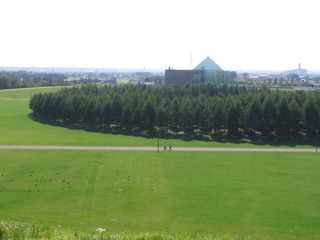
Here's Moere Beach and Moere Mountain in Moere Numa Park. Between them is a larch grove making the Sea Fountain invisible from outside.

The beach has ripples just like a calm friendly sea. A special gift to children living in Sapporo where real sea is far away.
Underneath the mountain is simply garbage. Which is inevitably produced in big cities. A mountain of garbage is now transformed into a small grassy hill, 62 meters high and recognized as an authentic mountain for the government-authorized map.


Moere Mountain from a different angle
If you come from the Sapporo area, Moere Mountain is the first you sea as a sign of the park. Completed and opened to the public in 2004, the mountain now looks very natural and part of the landscape. Sixty two meters high. Try climbing it. The mountain is very inviting.


Glassy Pyramid

This pyramid is a combination of a quadratic prism and a quadrangle. The structure gives you a different impression depending on from which side you see.


Inside of the GLASS PYRAMID. The 1st floor.

Sea Fountain


Sapporo does not face the sea. So the SEA FOUNTAIN is another gift to the Sapporo citizens. The fountain has shows, with pumps and motors operating under the fountain bowl, some of which last for 15-minute and the rest of which for 45 minutes.

The longer program creates waves in the center bowl.

A larch grove surrounds the fountain, hiding it from its neighborhood.