Showing posts with label Kyushu. Show all posts

Monday, March 21, 2022

nagasakibana in kunisaki peninsula, oita pref. is fun for everybody

It has the big blue sky, the placid ocean all around, seasonal flowers including canola and sunflower from which plant oil is being made, camping grounds, and above all outdoor art installations and a stimulating art museum. 

You can be there for two hours - please stay at least two hours - or more, even stay overnight in a cabin or a tent. It's good for everybody.

I went there because of art specifically installed there and appreciated both artworks and environment.

Though kunisaki peninsula has a lot to offer, nagasakibana is carefree and healthy and you do not need a lot of planning.

Their new establishment, an art museum named the Art Museum of Nature and Human Non-homogeneity is, though philosophical, can be good for families, too. 

Here's a one-minute introduction to the cape called nagasakibana, once abandoned farmland but now a beautiful resort filled with seasonal flowers.


Friday, March 18, 2022

what art can do to communities

Gormley's statue


Now there are many art festivals all across Japan. Such festivals can be said to have started with the one in the north of Japan called ECHIGO TSUMARI Art Triennale that started in 2000, followed by the Setouchi International Art Festival or Seto-gei which has been a great success since 2010.

In 2014, the Kunisaki Peninsula Art Festival was celebrated and it left its traces in many places of the peninsula, enhancing the innate potential the places had had.

One of the assets the festival left is a symbolic iron-cast statue made by Antony Gormley. It stands in the middle of the old local religious center and when it was planned to be installed, people discussed if it would be appropriate to install a naked iron statue cast by the real body of the artist. 

But now, the statue looks philosophical if not religious. For some people, however, the statue seems to be equivalent to a Buddhist statue to which, naturally, they would like to offer small money just like they do at temples and shrines. 

It was a heck of a job to carry the 630-ton iron statue up the mountain, for which local professionals helped. The process already involved locals and that must be a great contribution by art already.

The statue has been exposed to the elements and has been aging. He showcases passing time specifically here in the Kunisaki Peninsula.

The 630-ton statue was wired up


up the mountain path

 
 on the way remains a pair of guards


more on the way and now the statue is down below 


money offered at the bottom of the statue


 cave-like hall for the deva king 


 down the mountain


Tuesday, May 30, 2017

KIRISHIMA OPEN-AIR ART MUSEUM again

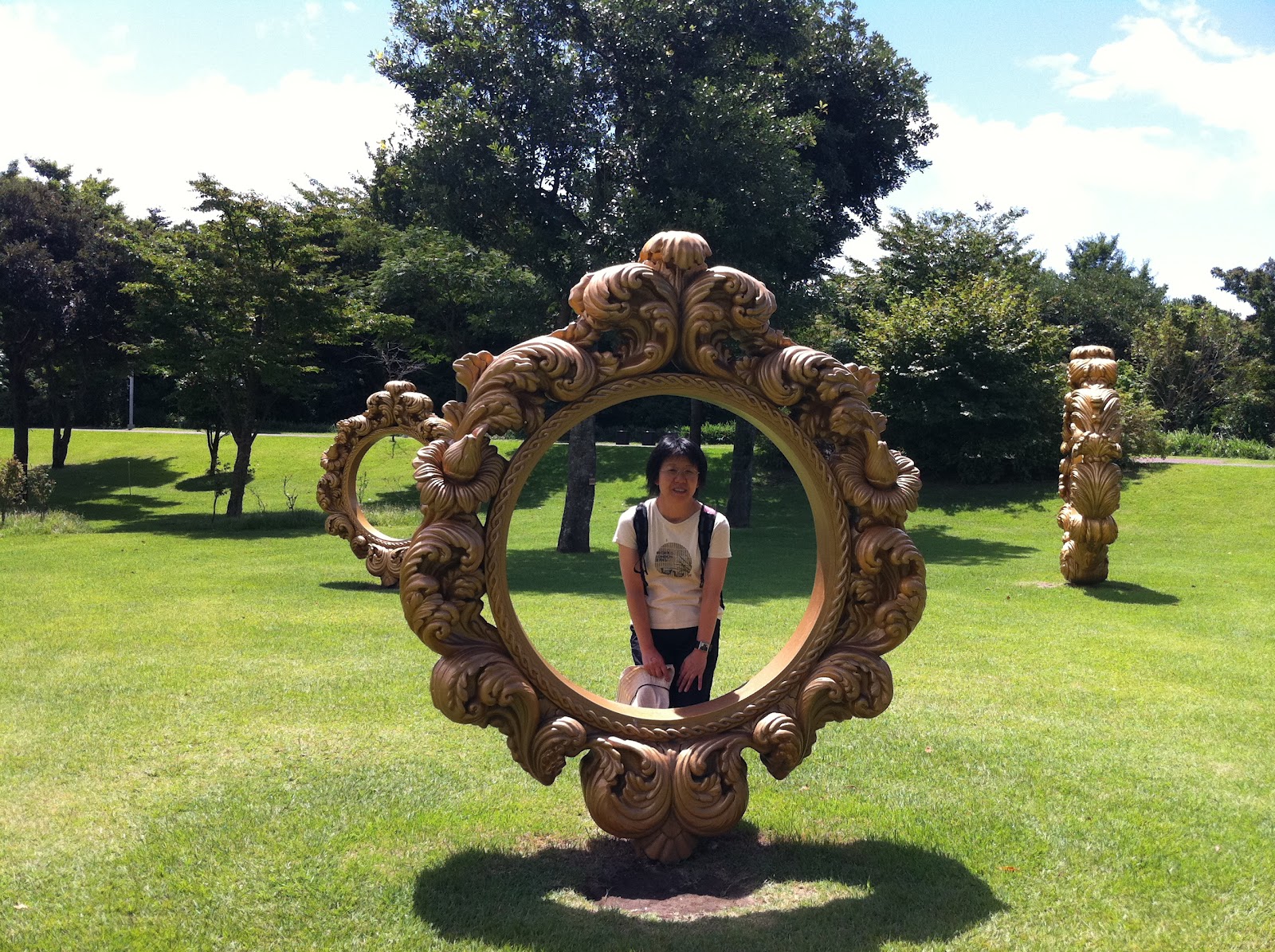
Here's an artwork so easily spotted and fun to play with. It's entitled YOU ARE THE ART. In your photo, you can be part of the art in your own way. Be creative!

And some others are hidden, intentionally or not. In the photo below, Jonathan Borofsky's Male/Female can be slightly seen. This large sculpture will be a clue to find this artwork, Sunny Spot.

Two more tucked in the forest:
  

There are many other but they are easy to come across with.
The museum also has an indoor gallery. 

Thursday, February 2, 2017

Mountain & Sea seen at once

SAKURAJIMA mountains & KAIMONDAKE mountain look good with the sea.
They sour in Kagoshima, Kyushu.
 
SAKURAJIMA seen from a city view bus


KAIMONDAKE seen from NAGASAKIBANA point


Sunday, January 29, 2017

Try KIRISHIMA

Try KIRISHIMA. Depending on the weather, you see something spectacular or nothing but fog and mist. Either way, the KIRISHIMA area where 20 some volcanoes sour are mind-cleansing. Ebino Kogen highland is a place for everybody with both easy and advanced courses available. This time no photos from the trekking. Easy trail but on a rainy day; hard to take pictures. But it almost stopped raining while visiting KIRISHIMA SHRINE. See a small shrine YAMA JINJA and magnificent cryptomeria trees on the shrine grounds which include hills behind the shrine buildings. 


 And nearby Maruo waterfall
This is onsen hot spring waterfall. Warm!


Saturday, January 28, 2017

KIRISHIMA OPEN AIR ART MUSEUM

The outdoor part of the museum is particularly refreshing. Including Jonnasan Borofsky's, site specific artworks are dotted on the premises. Inside in the Art Hall are exhibited works done by world-famous artists and local artists. Amazing collection but taking a stroll out on the grounds and visiting the artworks on the way will be fun for everybody regardless of interest in art. 

KIRISHIMA natural settings are beautifully presented but more efforts should be done by the Kagoshima prefectural government whose affiliate started the project of building this. Unlike Benesse islands in the seto inland sea whose evolution has been driven by someone powerful like Mr. Fukutake, this art museum does not grow. Or so does it not seem.
But if you are an art and nature lover, KIRISHIMA where this museum lies is a spiritual and inspiring place. Hiking around or even climbing one of 20 or so peaks should not be missed. Along with local legends and Japanese mythology surrounding these mountains you will come to touch with ancient Japan.
Forest Observatory; shadows of the trees surrounding the installation create this silhouette.


Tuesday, January 27, 2015

Gushing steam is the evidence of rich onsen water

The photo looks as if a disaster is taking place but in fact this is an ordinary sight in Kan-nawa, Beppu City, Oita Pref. Bellows of steam are everywhere due to onsen water welling up in Beppu. 
ordinary sight!

The water is so hot that it has to be cooled down using this simple device.

I wish I could bathe in onsen every day. In Beppu, it is easy: residents can visit public bathhouses in their neighborhood or they can have the onsen hot water drawn into their house by paying for the onsen water plan. Lots of visitors from Asia, not much from the west at this moment. If you are an onsen lover, however, I bet you would like to visit Beppu some day. In Kan-nawa, there are several facilities where you can steam your food. The food could be from local stores or what you brought along. By participating in the tour called Kan-nawa Marche, you can enjoy walking in the neighborhood and then a meal at a steaming station. It's a good deal to fully appreciate Beppu onsen.


Go to Oita Prefectural Museum of history and then to Fukiji temple

The history museum has remarkable replicas of historical assets in the Kunisaki Peninsula, Oita Pref. The photo below was taken in the lobby of the museum and photography is allowed there. 
In the lobby of the museum, a replica of the carved Cosmic Buddha is exhibited

In one of the exhibit rooms, the interior of the main hall of Fukiji temple is reproduced beautifully. It's so awesome that visitors would feel the reproduced statue of Amitabha Buddha should be the object of worship. 
Here the original colorful appearance of the hall and gold-leafed statue can be viewed. You can even walk around the central inner zone where the Buddha sits and see how the back of the statue looks like. Here is the link to the museum web site. 

After this, you should go to Fukiji temple and see the real hall and the statue. They were originally built in the eighth century. They've survived to this day but became antique over centuries. 
Head priest just closed the side doors. The front doors are always closed.


You will have a time travel with your imagination by visiting these two places one after another.

Tuesday, June 10, 2014

Hells in Beppu are rather colorful


Beppu's top attraction is touring the eight hells. The hells are in fact multicolored volcanic pits of boiling water and mud and one geyser. They are too hot to be diluted into onsen, and they emerge at temperatures ranging from 50 to 99.5 °C (122 to 210 °F). Some of the hells have a natural smell of sulfur — which comes out a bit like rotten eggs. See some of the hellish photos.


Saturday, June 7, 2014

Cool samurai @ kumamoto castle

KATO Kiyomasa is one of them

People love samurai castles. Only 12 original castle towers remain but more were reconstructed based on the original. The main castle tower of Kumamoto Castle connected with the minor tower is a concrete recreation built in 1970. In front of them lies a square where samurai members periodically gather and perform shows. In the photo is seen a tall ginkgo tree which was first planted at the beginning of the 17th century by KATO KIYOMASA, who expanded the existing fortress into a magnificent castle complex now known as Kumamoto Castle. He predicted something ominous would happen when the tree became as tall as the main castle tower. That grave event could have been the battle fought in 1877. The castle was besieged by unaffected former samurai members from Satsuma but was so well designed that it was not penetrated more than 50 days and most of the Satsuma troops moved a way from the castle to seek different tactics. Kumamoto castle has some old historical buildings which you cannot resist taking pics. But their reconstructions have been beautifully done and that's the way this castle has to offer you a lot to see.

Saturday, December 28, 2013

Yachiyo-za theater in YAMAGA, Kumamoto

Latticed ceiling with gas lighting and business ads
 
In a small city tucked in an inner northern Kumamoto lies a theater calls YACHIYO-ZA built in 1910. About 20 of this type of old-fashioned theaters remain in Japan today. YACHIYO-ZA uses gas light and the lighting equipment on the ceiling looks delicate. The lady who acted as a guide was quite an entertainer. I translated what she said into English but her enthusiasm was easily communicated to her audience. What a fun memory we all got. Dazaifu Tenmangu Shrine, Yamaga, ASO, and Kumamoto Castle make a great combination of diversity. It sure made a good tour.

Tuesday, December 10, 2013

Active Mt. ASO

Smoky crater!
 
One of the craters on Mt. ASO is active, which often makes the aerial cable service stop, usually connecting the lower station next to a large parking lot and the upper station near the crater. As the phot suggests, it was a clear crisp day, ideal to view the peaks, sommas, and caldera basin. But of course the cable did not work at least for a while and visitors were not allowed to go to the closest area to the crater when it worked. This photo was taken from the area called KUSA SENRI, now a grassy field but once a crater. The life cycle of the active crater is pretty much predictable and that's why tourists are allowed to go to the crater area when the gas situation is tolerable. Try your good luck and go for Crater No. 1, the only active crater of Mt. ASO.

Near the lower cable station
 

Three towers seen at the same time in Kumamoto Castle grounds

 Taken near the largest parking lot 

No utility poles and wires! This must be how it originally looked when built at the beginning of the 17th century by KATO Kiyomasa, a feudal lord noted for his excellent castle building technique. Two of the towers are reconstructions in the 20th century but one is from the  castle's inception. Thanks to the inauguration of Kyushu Shinkansen services, Kumamoto is easy to go to. Try the castle and perhaps Mt. ASO as well and you will feel the grandeur of Kyushu. 

Monday, April 30, 2012

Stone Buddha in Usuki, Oita

The Cosmic Buddha in the Furuzono Gallery
Usuki Daibutsu Stone Buddhas are about six kilometers away from JR Usuki Station. It seems there's a free bike rental service at the station. Could be possible to go there by bike I wonder. Also accessible by bus from Usuki Station. I went there by car from Beppu with my guests so it was too easy. 


The Buddha sculptures, designated as national treasures, are roughly 1000 years old. There are four galleries and two of them are easy access with gentle slopes. One of the two is the best of the four: Maha Vairochana or the Cosmic Buddha flanked by 12 others is magnificent. Once the Buddha's head was dislocated and was sitting on the ground. After discussing what to do for ten years, researchers agreed that the head be restored. 


When in Usuki, don't miss the Inaba Residence built for the former Inaba lord to stay when he was back in Usuki coming back from Tokyo. It has a lovely garden which retains the old samurai house garden atmosphere yet with a tinge of the modernity from the Meiji period. The house was built in 1902 in the Meiji period but looks like an authentic senior samurai house from the Edo period.


Oita Prefecture has many stone Buddhas sculpted from the tuff-hillside, making a striking difference from other parts of Japan.


Buddha's head sitting on the ground

Sunday, September 11, 2011

Chiran samurai gardens, Kagoshima, Kyushu


Chiran samurai residence street
Nice podocarpus and tea tree hedges; elegantly curved streets always swept clean; seven gardens from the Edo period open to the public; Chiran tea served at the Mori garden is tasty. The lantern that can be transformed into an umbrella or even a weapon is pretty and clever. This used to be a samurai town where they disciplined themselves and farmed when not on duty. Sometimes they accompanied their lord to Kyoto, who was entrusted Chiran by the Shimazu lord who reigned the whole Satsuma or present Kagoshima Prefecture. That's the way they learned Kyoto culture and first class gardens with aesthetic use of local tastes were made.
The Mori garden; the other six are dry landscape gardens.
The lady at a small store at the central parking lot is always friendly and welcoming visitors. Love the place and people.

Majestic Kumamoto Castle in Kumamoto, Kyushu

The central compound where the castle towers soar


The origin of the castle goes back to the middle of the 15th century when fortifications were made on the hill; then expanded and finally in 1588 KATO Kiyomasa, a trusted vassal of TOYOTOMI Hideyoshi (the first ruler all over Japan), was dispatched to the early incarnation of Kumamoto Castle and built this grand, extremely fortified castle. The castle complex consisted of a large castle tower, a small castle tower, 49 turrets, 18 turret gates, and 29 smaller gates. The Honmaru Goten Palace was completed in 1610.

The Kato clan, however, was ousted in 1632 by the Tokugawa shogunate and replaced by the Hosokawa who reigned for 239 years, the rest of the Edo period. One of the Hosokawa descendants became prime minister of Japan but didn’t last long as has been often the case with other successive prime ministers. Ugh.

Most of the castle buildings were mysteriously burned down three days before the castle was besieged and attacked by the disaffected former samurai members from Satsuma in 1877. This is part of the very complicated and dramatic history of Bakumatsu (toward the dismantling of the Tokugawa shogunate) and the beginning of the new government, Meiji.

The castle still retains 13 original buildings including remarkable Uto-yagura turret, and most of the important castle buildings are now reconstructed.

Some samurai members stand by for you. They talk like samurais but are happy to be photographed with you. 

And this spring, the fun facility Josai-kan was completed, located at the foot of the hill. There's Wakuwaku-za on the Josai-kan premises, a sort of fun museum, where you can wear costumes from the samurai era.


See my picasa album for more fun.


Shokun-no-ma in the grand Palace

Wednesday, September 7, 2011

Kirishima Open-Air Museum, Kagoshima

Obviously Kusama's
I wanted to check this place out because works by KUSAMA Yayoi, Richard LONG, MIYAJIMA Tatsuo, AOKI Noe, ONO Yoko, Isamu NOGUCHI, etc. are displayed there. And it's good to go to highlands in summer for cooling down. 


Seems to be an ideal location for taking your children. The nature is beautiful and kids can play in the unaffected yet artistic atmosphere.


Not just one. They stand in a forest.

You are special !


Tuesday, September 6, 2011

Aso is accessible by train and bus

If you love to travel by train, Kyushu is one good destination that you can enjoy attractive trains. 


Aso is accessible by taking a train at Kumamoto Station. Some of the trains go straight to Aso without transfer; many others need transfer at Higo-otsu but on the same platform. Roughly takes 1.5 hours and costs 1080 yen. Not bad. There's a charming limited express called Kyushu Odan Tokkyu, meaning the Trans-Kyushu Limited Express. Taking 1hour and 13 minutes, the train takes you from Kumamoto to Aso. For this you need extra 900 yen.


There should be bus services taking you to higher places of Mt. Aso. I loved staying at a pension located higher up. Very refreshing. 


Instead of getting off at Aso, you can try Miyaji, six-min-train ride away from Aso. Walk 15 to 20 minutes from the station and you are arriving at Aso Shrine and its neighborhood. Water is good here as is often the case in many parts of Kumamoto. 


Aso Shrine must have originated from mountain worship in ancient times. People felt awesome about explosive Mt. Aso, which has been harsh and generous at the same time. That's how mother nature should be in this country and you naturally feel humble when embraced by this type of surroundings. 


The approach to the shrine does not lead perpendicularly to the shrine buildings but in parallel with the lined up halls. The approach rather looks like leading to Mt. Aso and you will be impressed by the mountain seen from the precincts.


Local kids are often around the shrine, making the area friendly and peaceful. 


On the premises stand some interesting objects such as a wishing stone (you rub it and make a wish), a love pine tree (you and your significant other go around the tree in opposite directions; when you meet you two pray for your eternal love; young couples feel like kissing there), and a scale you can take a measurement of your child's height (my fun loving guests pretended that their mug shots were taken; very funny).


Aso's drinking water and bathing water are both good. You will be cleansed from inside and outside. Good deal, isn't it?