Monday, December 12, 2011

Nunakuma Shrine in Tomo

This pillar was dedicated by a trading house Osaka-ya
according to the inscription. 
More than 1800 years ago, Empress Jingu called on Tomo on her way to western Japan. She came back on her way back. Knowing the divinity was not enshrined, she prepared a sanctuary and summoned Owatatsumi-no-mikoto from the sea. Watasu Shrine was legendarily founded somewhere in Tomo that way.


The present Nunakuma shrine was originally called Gion Shrine, the mother shrine of Kyoto's Gion Shrine (now called Yasaka Shrine and famous for its summer festival). But the Meiji government, promoting the separation of Buddhism and Shinto, demanded the name be changed into something which did not carry Buddhist significance. The old historical name, Nunakuma, was chosen and since then the shrine has been called Nunakuma Jinja and Owatatsumi was invited here as the central divinity in addition to the original host Susano-o in 1876.


Here, take a good look at the structures made of rocks, such as Torii gates, stone stairs and pillars, and smooth oval rocks which were used for strength contests. 


A Noh stage which can be disassembled and made portable sits there. It's an old stage from the beginning of the 17th century. The stage is still used by locals and seeing the Noh performance outdoors must be a lot of fun. But it might just look insignificant to the eyes of travelers when nothing is happening.


The shrine visit will add a spice to your temple hopping exploration.
Macho port workers competed on their strength.

Sunday, December 11, 2011

Temples in Tomo-no-ura

There are 19 temples in Tomo. Considering the fact that the town is 600 meters wide from east to west and less than 1 kilometer from north to south, this number is quite large. It is believed that there were nearly 30 temples in the Edo period when the town was prosperous with transit trading.

The oldest is said to be Jokan-ji built around 810 followed by Io-ji on the hill allegedly founded in 826 by Kukai, a great Buddhist monk and cultural hero who, according to local legends, dug wells and built temples instantly. Tomo is likely to have had at least three temples in the ninth century including these two and the other which does not exist anymore.

Ankoku-ji Shaka-do (Sakyamuni Hall)

Ankoku-ji, originally built in the 13th century under a different name, was renamed in the 14 century by ASHIKAGA Takauji, who ordered the construction of Ankoku-ji temples and Risho-to towers nationwide wishing for the repose of the war dead. The temples and towers were especially dedicated to the late Emperor Godaigo, who was opposed to Takauji and escaped to Yoshino, Nara where he died in frustration.


Amitabha trio
See the attendants' elegant hand postures
Ankoku-ji’’s high status didn’t allow it to have parishioners as financial supporters. Sometimes the temple was in dire situation. Historically and academically, however, this is an important temple. The Shaka-do (Sakyamuni Hall) that enshrines not the Sakyamuni trio but the trio of Amitabha Buddha and his attendants is a significant example of architecture from the 13th century which utilized techniques introduced from Buddhist monks and others fleeing Sung China whose authority was waning and about to be replaced by Yuan Dynasty.

Part of the stately tomb stone at Ankoku-ji,
built by a merchant family in the Edo period

Most of the existing temples were built under the order of FUKUSHIMA Masanori who was dispatched at the beginning of the 17th century to present day Hiroshima Prefecture by TOKUGAWA Ieyasu, the first shogun of the Tokugawa Shogunate, who established peace and stability. Many line up one after another. 


FUKUSHIMA Masanori expanded the already-existing fortress into Tomo Castle. The central citadel was built on top of the hill now situated in the middle of the historic area of Tomo. In those days, the castle stood at the edge of the land but the seashore has receded due to reclamation. The lord too reclaimed some land and that's how Taiga-shima island became part of the main land. He moved Enpuku-ji temple from its original location onto the hill of the former island, a vantage point to overlook the waters and the location of a stronghold during the middle ages. 


The construction of the castle town continued and the planning was grand, which made TOKUGAWA Ieyasu upset and skeptical about his loyalty, leading to the demolition of the castle probably in 1609.


Walk along the temples and see some of your favorites carefully, thinking about the lord who was not a true sympathizer of the Tokugawa clan and demoted to a smaller domain after his short reign in Hiroshima. 
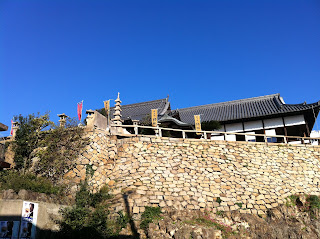
Io-ji on the hill

Refined Ota Residence in Tomo


See the elegant design of the railing

The Ota Residence is surrounded and protected by its whitewashed liqueur making factory buildings and the Choso-tei guest house stands across the alley. They were built around the middle of the 18th century to the beginning of the 19th century. The Choso-tei, meaning the house for audience to nobles, is still a residence of the family who owns it and is not open to the public but its exterior can be enjoyed especially when seen from a distance across the bay. The Ota Residence is open to the public and the staff members there give you a guided tour in Japanese.

The ownership shifted from the Nakamura family to the Ota family in the Meiji period. NAKAMURA Kichibei, who moved from Osaka to Tomo some 360 years ago, started to produce Homei-shu liqueur and his family thrived as an exclusive manufacturer of the liqueur regulated by the Fukuyama Domain. The affluent family continually expanded their residence and factory. They were obliged to greet and offer lodging to VIPs during the Edo period. Thus the architecture was unaffected but sophisticated, following the manners popular in Kyoto. Both the residence and factories are superb examples of grace and refinement. You have to take time to appreciate the details and it’s worth doing so.

SANJO Sanetomi and his company, aggressive anti-shogunate and pro-imperial court nobles, were one of the most noted guests. They were fugitives from Kyoto when they called on the Nakamura residence in 1863 and 1864. Sanetomi’s Tanka poem made in Tomo in 1864 goes:

世に鳴らす 鞆の港の 竹の葉を かくて嘗むるも めずらしの世や
Tasting the reputed liqueur of Tomo Port in such an unexpected situation


The tastefully designed wooden floor
Inside the former liqueur factory

Tomo-no-ura overview

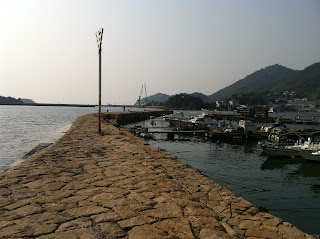
Old pier called Hato built in the Edo and Meiji periods

Tomo is located in the center of the Seto Inland Sea region and lies 14 km south of JR Fukuyama Station. It protrudes into the Inland Sea at the southern end of the Numakuma Peninsula. The two different tides from the west and the east, meet in the waters off Tomo, which once forced the travelers to stop at Tomo for fair tides and winds to continue their voyages. Fortunately, Tomo’s terrain was ideal for a port. The hills close in to the small flatland and no river runs into the bay, which contributed to make an ideal port of required depth. And of course, Tomo’s inlets were quite suitable for a good moorage.


Tomo is a rare place still retaining the five essential elements for the ports in the Edo period [1603-1868]: 

Gangi stairs running into the sea;
Torodo stone lantern once provided a beacon light;
Hato piers made of stacked stones
The ruins of Funabansho maritime office
Tadeba dockyard where the outer ship bottoms were cleaned  

Since ancient times when the Anthology of Myriad Leaves was compiled in the 8th century, this once thriving port town has been called Tomo and the same character 鞆, invented in Japan, has been used. That will already convince you what a long and proud history the small port town should have. The town was referred to in the poems of the above-mentioned anthology eight times.

In the 12th century, the court ladies of the once glorious TAIRA clan are said to have been abandoned at Tomo when their troops were escaping from the emerging MINAMOTO forces. The ladies had no choice but to engage in the oldest business in the world.

In the turbulent 14th century, Tomo witnessed battles caused by power struggle in Kyoto in many ways. Kogarasu Shrine where battles were fought still stands although the configuration of the area seems to differ largely from the days of the fighting.

Tomo triggered the Ashikaga clan’s resurgence because ASHIKAGA Takauji received the letter of imperial approval while in Tomo after being ousted from Kyoto and in 1338 he was appointed shogun, starting the Ashikaga Shogunate. Ironically the 15th and last Ashikaga Shogun took refuge in Tomo to revive his authority from ODA Nobunaga in vain.

In the Edo period, when peace was finally established at the beginning of the 17th century, the diplomatic relationship between Korea and Japan was restored and the Korean friendship mission visited Japan 12 times (though they had to stop at Tsushima one time and didn’t come to Tomo as well as Capital Edo). They spent some days at Tomo on their way to Edo and their way back to Korea. That was a pleasure both for the Korean delegates and Tomo locals. Literati came over to meet with the intelligent guests from overseas.

More recently, famed animated film director MIYAZAKI Hayao stayed in Tomo for a while, conceiving of his film “Ponyo,” a story about a little mermaid-like goldfish and a human boy. Now Ponyo’s pictures are commonly seen along the streets of Tomo.

Dr. Donald Keene, a highly respected scholar of Japanese literature, recently retired from Columbia University in 2011 and moved to Japan permanently. Many years ago a school in Fukuyama invited the professor to give a lecture and kindly arranged an overnight stay at the island of Sensui-jima, five minutes’ boat ride from the Tomo terminal, after his lecture. He said he wandered in Tomo alone since he didn’t have a guide. Later he wrote a lyrical article about Tomo in the Yomiuri Newspaper. Some stores in Tomo post the article where it can be seen easily. One store owner said she reads the article occasionally and I saw it framed and hung on the wall. The article advised tourists to be considerate and keep this precious gem intact. I felt like crying.

Any place would inspire you if you listen to the distant voice from numi carefully. This time I had a chance to listen to the message and the affair with Tomo seems to last for quite some time.
Taicho-ro guest house on the premises of Fukuzen-ji temple
Taicho-ro means "the pavilion located where the two tides meet"
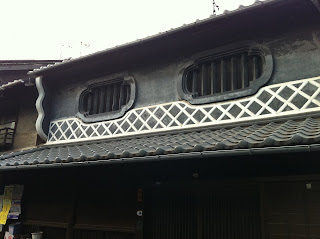
One example of the Tomo Architecture
Houses with this type of plastered walls and windows
were built at the beginning of the 20th century.
Note one of the partitions at the end of the wall on the 2nd floo
r.

Saturday, December 10, 2011

Tomo-no-ura prelude

Ota Residence; photo taken in the courtyard

Tomo-no-ura is a hidden gem. Though many travel agents and tourists already discovered Tomo, they often leave without knowing its entire significance. 

Tourists should all find Tomo quite interesting, taking a walk around the old port from the Edo period, visiting the former temple guest house where the Korean friendship missions dispatched during the Edo period (1603-1868) stayed (one misson said the scenery from the guest house was the best along the route from Korea to Edo), given a guided tour at the grand merchant house built some 200 years ago, and seeing aged but characteristic wooden houses where people of Tomo live.

These are already very interesting for you to spend a few hours. But you can easily spend another few by becoming explorers. In fact, instead of some hours, staying in Tomo for two nights is not bad at all. In that case, don’t forget to rent a bike and visit Abuto Kan-non. Or if it’s too much to go up the slope, take a taxi for ten minutes or maybe just walk. It’s only five kilometers and you won’t regret the walk. The view is remarkable and refreshing.

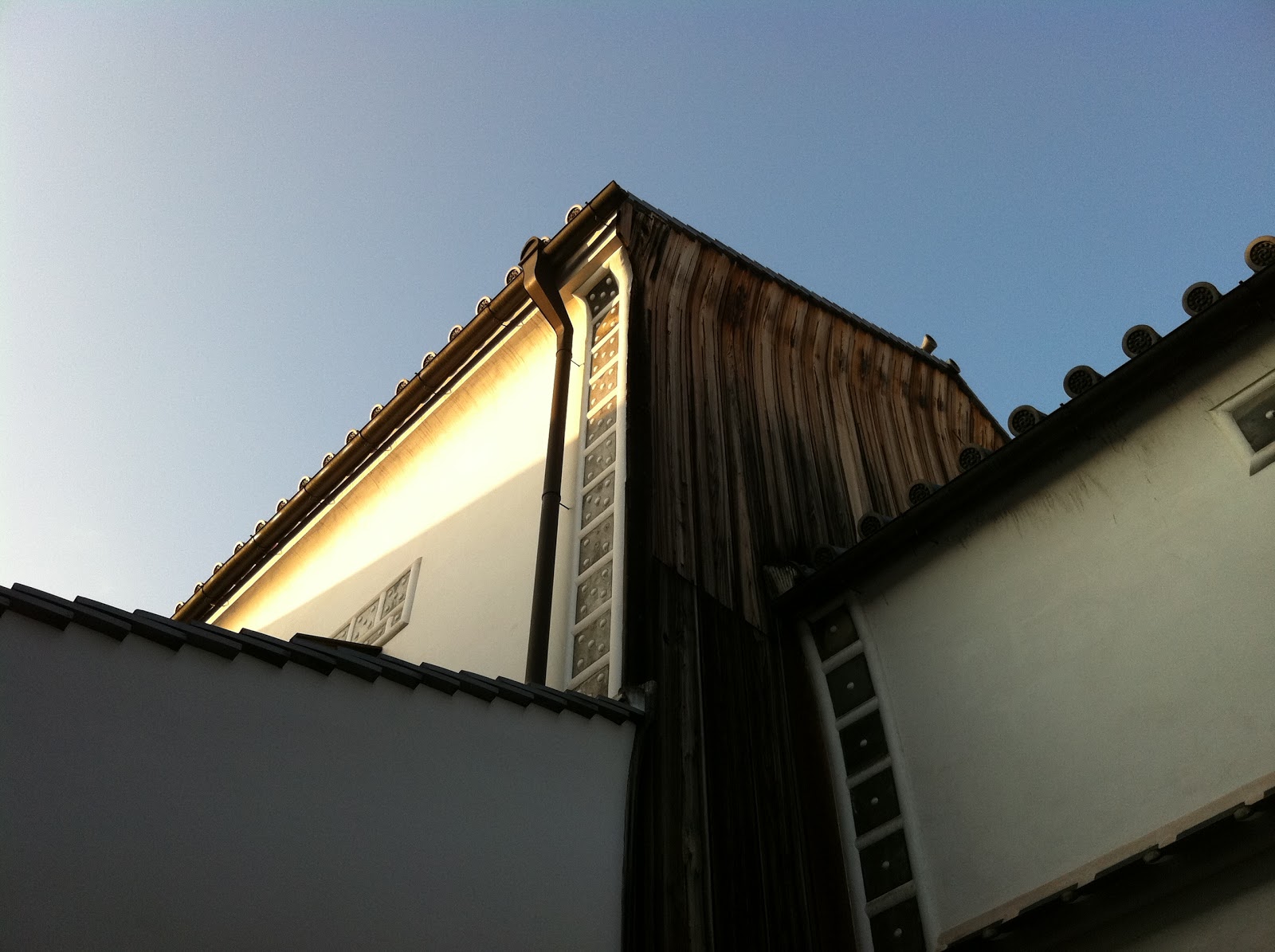
The Ota Residence and the Taichoro Guest House must be two major destinations in Tomo. This time, just to start up, let me show you only a portion of the Ota Residence. After the house tour, try walking in the alley behind the residence. The black tiles with white dots protecting and adorning the walls; wooden boards joined by quality nails covering the lower part of the walls (they were originally part of a ship and the nails are rust free). They will quietly talk to you once you are away from the crowd.
Photo taken from Abuto Kan-non Hall

Tuesday, November 8, 2011

The mythical world of Koji-kin, Aspergillus oryzae


Looking at the storage tanks at Saijo Tsuru
What's Koji-kin? What's Aspergillus Oryzae? 


This microbe is indispensable for sake making. 


There are a lot of amazing and intriguing facts about sake brewing. Comparing how wine, beer, and sake are produced will make your love and appreciation to these beverages deeper. 


So here's a little tidbit. This time mainly about Koji-kin.


The grape juice already has sugar in there and it will be fermented into alcohol. And the wine is ready, though wine making is much more than that of course.


The barley has to be malted so that the starch in barley should be turned into sugar, which will be fermented by the yeast to alcohol named beer. These are sequential processes, one step at a time.


The sake rice ready to be used for sake making is already without husks. Thus no malting process is involved in sake making. In addition, the rice is first milled. Sometimes down to 35 % of the original weight if it's for Dai-ginjo premium sake. The milling ratios of the rice range from 70 % to 35 %. The rice powder is used for other purposes such as the ingredient for snacks, animal feed, etc. so don't worry.


The milled rice is still rice and does not have the sugar to be eaten by yeast cells and cause the fermentation process. Here comes the Koji-kin or Koji spores. Their scientific name is Aspergillus Oryzae.


The Koji spores are sprinkled over the steamed rice and they begin to propagate, making Koji-molded rice. This molded rice containing glucose is the food for yeast cells.


The Koji-molded rice, steamed rice, and pure underflow water are mixed in a vat and the yeast is added to the mixture. The yeast cells are happy with the food and the fermentation process begins while the starch in rice continues to be broken into the sugar by the enzyme the Koji spores produced. 


First the starter mash has to be prepared, followed by the serious fermentation process for 20 to 30 days. 


These processes, saccharification and fermentation, take place at the same time in the same vat. Not sequential processes like in the beer making.


The sake breweries have the special room, Koji Muro, where the Koji-molded rice is prepared. It's a delicate process which has to be controlled and monitored carefully.


In this photo, two of my guests are taking a look at the tanks where the fermentation stage is happening at the factory of Saijo Tsuru, Saijo, Hiroshima. Toward the end of November, breweries have their products of this year, their new sake. 


My husband is a great fun of Shinzui produced by Saijo Tsuru, one of the breweries in the Saijo Sake Brewery Street. This superb product is naturally pricey. I promised him to buy him a bottle for the new year's celebration if he tries to be a good boy. He has a month and a half to go.  We'll see.

Wednesday, October 5, 2011

Tom Na H-iu in Teshima


Yes, I managed to visit Teshima again. This time in early fall when rice fields are colored gold with bowing rice ears.

I rode a bike around the island, looking at artworks. Teshima has some difficult hills but the riding was VERY easy and smooth because the bike is electrical and of three gears. 

Before this visit, I walked in the island which enabled me to slow down and see well. Also I enjoyed talking with the islanders and staffers, which you cannot do in a fast pace. 

But biking is refreshing and provides you with easy transportation measures.

I liked both.


This time I'm sharing MORI Mariko's artwork. 
The approach to her work standing in the middle of static water is fantastic and  essential. 
The following description is from Flavorpill NEW YORK

Deitch Projects says…
Like many visionaries, Mariko Mori combines the ancient with the futuristic in her fantastical sculptures. At Deitch Projects, Mori presents three new works, including the glowing 15-foot-tall Tom Na H-iu, inspired by Celtic funeral rituals, but created with intelligent LEDs connected to the Super Kamiokande neutrino observatory at the University of Tokyo. The orb-like monolith changes color as researchers on the other side of the world capture different varieties of the miniscule particles emitted by dying stars. Twenty-two ceramic stones surround a replica of an ancient vase inFlatstone, mimicking the space of a shrine from Japan's ancient Jomon civilization. Roundstone is a horizontally placed, luminescent orb, meant to evoke the Jomon-era practice of placing stones near the hearth to ensure a bountiful harvest.


This pdf also write about MORI Mariko and her artworks.