Tuesday, November 8, 2011

The mythical world of Koji-kin, Aspergillus oryzae


Looking at the storage tanks at Saijo Tsuru
What's Koji-kin? What's Aspergillus Oryzae? 


This microbe is indispensable for sake making. 


There are a lot of amazing and intriguing facts about sake brewing. Comparing how wine, beer, and sake are produced will make your love and appreciation to these beverages deeper. 


So here's a little tidbit. This time mainly about Koji-kin.


The grape juice already has sugar in there and it will be fermented into alcohol. And the wine is ready, though wine making is much more than that of course.


The barley has to be malted so that the starch in barley should be turned into sugar, which will be fermented by the yeast to alcohol named beer. These are sequential processes, one step at a time.


The sake rice ready to be used for sake making is already without husks. Thus no malting process is involved in sake making. In addition, the rice is first milled. Sometimes down to 35 % of the original weight if it's for Dai-ginjo premium sake. The milling ratios of the rice range from 70 % to 35 %. The rice powder is used for other purposes such as the ingredient for snacks, animal feed, etc. so don't worry.


The milled rice is still rice and does not have the sugar to be eaten by yeast cells and cause the fermentation process. Here comes the Koji-kin or Koji spores. Their scientific name is Aspergillus Oryzae.


The Koji spores are sprinkled over the steamed rice and they begin to propagate, making Koji-molded rice. This molded rice containing glucose is the food for yeast cells.


The Koji-molded rice, steamed rice, and pure underflow water are mixed in a vat and the yeast is added to the mixture. The yeast cells are happy with the food and the fermentation process begins while the starch in rice continues to be broken into the sugar by the enzyme the Koji spores produced. 


First the starter mash has to be prepared, followed by the serious fermentation process for 20 to 30 days. 


These processes, saccharification and fermentation, take place at the same time in the same vat. Not sequential processes like in the beer making.


The sake breweries have the special room, Koji Muro, where the Koji-molded rice is prepared. It's a delicate process which has to be controlled and monitored carefully.


In this photo, two of my guests are taking a look at the tanks where the fermentation stage is happening at the factory of Saijo Tsuru, Saijo, Hiroshima. Toward the end of November, breweries have their products of this year, their new sake. 


My husband is a great fun of Shinzui produced by Saijo Tsuru, one of the breweries in the Saijo Sake Brewery Street. This superb product is naturally pricey. I promised him to buy him a bottle for the new year's celebration if he tries to be a good boy. He has a month and a half to go.  We'll see.

Wednesday, October 5, 2011

Tom Na H-iu in Teshima


Yes, I managed to visit Teshima again. This time in early fall when rice fields are colored gold with bowing rice ears.

I rode a bike around the island, looking at artworks. Teshima has some difficult hills but the riding was VERY easy and smooth because the bike is electrical and of three gears. 

Before this visit, I walked in the island which enabled me to slow down and see well. Also I enjoyed talking with the islanders and staffers, which you cannot do in a fast pace. 

But biking is refreshing and provides you with easy transportation measures.

I liked both.


This time I'm sharing MORI Mariko's artwork. 
The approach to her work standing in the middle of static water is fantastic and  essential. 
The following description is from Flavorpill NEW YORK

Deitch Projects says…
Like many visionaries, Mariko Mori combines the ancient with the futuristic in her fantastical sculptures. At Deitch Projects, Mori presents three new works, including the glowing 15-foot-tall Tom Na H-iu, inspired by Celtic funeral rituals, but created with intelligent LEDs connected to the Super Kamiokande neutrino observatory at the University of Tokyo. The orb-like monolith changes color as researchers on the other side of the world capture different varieties of the miniscule particles emitted by dying stars. Twenty-two ceramic stones surround a replica of an ancient vase inFlatstone, mimicking the space of a shrine from Japan's ancient Jomon civilization. Roundstone is a horizontally placed, luminescent orb, meant to evoke the Jomon-era practice of placing stones near the hearth to ensure a bountiful harvest.


This pdf also write about MORI Mariko and her artworks.

Thursday, September 29, 2011

Arte Piazza Bibai


Arte Piazza Bibai is stone sculptor YASUDA Kan’s creation.

Once there stood an elementary school. Most were lost as Bibai lost its edge as a coal mining community. Fortunately, one school building and a gymnasium were saved from dismantling and now function as artistic facilities at Arte Piazza. The first floor of the former school building even serves as a kindergarten, fully rehabilitated and getting more children due to its serene, friendly and artistic environment YASUDA created.


Enjoy some of the photos taken on September 12, 2009 when I joined the day tour to Moere Numa Park and Arte Piazza.


Here you see a former school building. Schools have to be where children's heart and mind grow. Young people deserve well-designed school buildings and surroundings.


Wednesday, September 28, 2011

Isamu NOGUCHI & Moere

The rooftop of the GLASS PYRAMID

This article first written in September 2009 and compiled in September 2011


Isamu Noguchi designed the railings of the two peace bridges in the city of Hiroshima. His Japanese father worked as a professor at the university in Tokyo I graduated from. And above all, what he did was very attractive to me, especially the so-called earthworks of his. He once said, "One day I had a vision: I saw the Earth as sculpture." 

Due to these facts, Noguchi’s name has always been in my mind. So when I first came across a bit of information about Moere Numa Park, which I instantly knew I would love, I was convinced that someday I should be there. I do not exactly remember my first encounter with Moere but it should have been about ten years ago.

For many reasons, I couldn’t make it up to now but I gratefully feel that was destined that way. The grand opening of the park was in 2005. If I had been there earlier than that, I could have missed some of the works “sculpted” on the earth of the park. The time was just right and Mother Nature treated me kindly, providing the perfect weather.

Noguchi first came to Sapporo, Hokkaido on March 30, 1988. He was already at an advanced age of 83. He was shown three candidate locations suggested by the city of Sapporo for the planned grand park. One of them was a garbage dump site which the city had already started part of the transformation into a large spacious park. The city started the groundwork in 1982. Fortunately, however, when Noguchi saw the site, it was still barren and garbage was flying in the wind. No wonder because 2.7 million tons of garbage was brought in before the waste treatment plant in Moere Numa was finally closed in 1990.

In a sense, the land had not been tampered by anyone (except by the general public who produced the garbage) and it had to be infused with vision.

I believe that was much better than those already formed and shaped and nicely prepared in accordance with mediocre plans and designs.

Moere was what Noguchi showed keen interest in.

It’s never easy to give birth to any sort of things. But Noguchi was quick to come up with the ideas. In November, 1988, he presented the final master plan for the park.

When he had a meeting with the man who later became the director of the completed park in November, he showed the models of the park and the Black Slide Mantra for Odori Park in downtown Sapporo and jokingly said, something like “Now you can do without me.” This meeting turned out to be the last.

He passed away of pneumonia on December 30, 1988, leaving the master plans for the park and the Black Slide Mantra. He was 84.

Moere Numa Park is 189 hectares (467 acres) in area, larger than half the size of Central Park in NYC.


Dreamy MOERE NUMA PARK

This article first written in September 2009 and compiled in September 2011
Play Mountain


Moere Numa Park in the suburbs of Sapporo, Hokkaido has always been in my heart for the last ten years. The time has come; I had to go; and it was the right move. 

A  short TV program featuring Arte Piazza Bibai, lying about one-hour-drive away from Sapporo, made me convinced that I had to go to Hokkaido. I somewhat knew that it was time to finally go to Moere. The combination of Moere and Arte seemed just right and made sense to me.

Then the wonderful thing happened. I checked the Arte web site to find that a day tour to Moere and Arte was available soon and the tour was set only one time.

I called the agency, made a reservation, and started other arrangements like flight between Hiroshima and Hokkaido, accommodations, etc.

Lots to write, but first, look at the pictures. The stories will come much later. I just need to show you some of the pictures without any further delay.

Let me start with PLAY MOUNTAIN. The 30-meter-high mountain cheerfully attracts you and you'll feel you are free of any scale.


Play Mountain & Tetra Mound 
Music Shell & Play Mountain

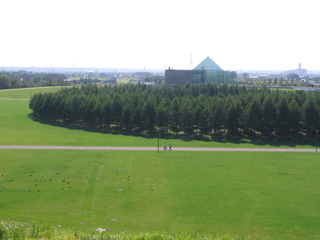
Here's Moere Beach and Moere Mountain in Moere Numa Park. Between them is a larch grove making the Sea Fountain invisible from outside.

The beach has ripples just like a calm friendly sea. A special gift to children living in Sapporo where real sea is far away.
Underneath the mountain is simply garbage. Which is inevitably produced in big cities. A mountain of garbage is now transformed into a small grassy hill, 62 meters high and recognized as an authentic mountain for the government-authorized map.


Moere Mountain from a different angle
If you come from the Sapporo area, Moere Mountain is the first you sea as a sign of the park. Completed and opened to the public in 2004, the mountain now looks very natural and part of the landscape. Sixty two meters high. Try climbing it. The mountain is very inviting.


Glassy Pyramid

This pyramid is a combination of a quadratic prism and a quadrangle. The structure gives you a different impression depending on from which side you see.


Inside of the GLASS PYRAMID. The 1st floor.

Sea Fountain


Sapporo does not face the sea. So the SEA FOUNTAIN is another gift to the Sapporo citizens. The fountain has shows, with pumps and motors operating under the fountain bowl, some of which last for 15-minute and the rest of which for 45 minutes.

The longer program creates waves in the center bowl.

A larch grove surrounds the fountain, hiding it from its neighborhood.


Tuesday, September 20, 2011

Eight Saijo sake breweries near the railroad station

The red roundish stamp on the smaller one images a ceder ball hanging at breweries;
the final stamp you get when you are finished with your walking rally.

See nine stamps we got!


The first ART in Sakagura event is now being held until September 25, 2011. A lot of fun to see the artworks done by local college students displayed in the areas of the sake factories that are usually off limits. They are planning to make this event annual. Good job!


The flyer for the event is well-done, carrying unaffected, friendly, artistic atmosphere. My friend and I loved the nine seals used for the stamp rally. We happily walked collecting stamps at nine locations around the sake factories. Start with Stamp 01 and collect the rest and you are given nine animated images depicting sake making in sequence.


Click and see the flyer and signs for the event. Pretty good.


Nine sake breweries in Saijo, Higashi-hiroshima joined hands under the collective brand name, Saijo Sake, with the slogan, Taste Japan.


Eight of them have their factories and offices near JR Saijo Station, making your stroll into the Sakagura Dori (Sake Brewery Street) simple and easy.


How sake is made, the history and development, etc. are all interesting topics but once at the street, please taste Japan, which means not only sipping sake but also using all your senses to experience the local magic. You might slightly smell fragrant sake at each brewery though this year's sake making has not started yet, which I thought was very special.


Here let me give you a quick summary of the eight breweries to encourage you to visit all of them. If you'd like to buy bottled sake, I recommend you do it after you've visited them all. I believe you do not want to carry the bottles around while enjoying your walk. You can easily go back as the sake brewery zone is not that large. The breweries are listed in the model walking course.


1. KAMOTSURU
The largest in the area; well-established; large premises good for photo taking; can casually taste several kinds of sake as well as sake-making water in the former sake making building.


2. FUKUBIJIN
Founded and adopted the modern corporation system for the first time in the sake industry in 1917; once served as a sake-making school; has the tallest chimney (27 meters).


3. KAMOIZUMI
Famous for the junmai ginjo (refined pure rice sake) with a tint of gold due to no carbon filtering; Shusenkan, which accommodates a sake cafe/shop (sake cosmetics/soap, sake goods, their sake, sake sweets, etc on sale), sake library (you can sit down and take a rest free of charge), and others, is open on the weekend and holidays; at the sake library, the KAMOIZUMI sake introduction video, narrated in English, can be watched freely. It lasts about 25 minutes. One of the three narrators was no other than me to reduce the video production cost. The translation was done by me helped by the other two narrators who happened to be both Canadians.


4. KIREI
Tastes beautifully dry and clear; the store carries interesting food (udon noodle for example), snacks and goods besides sake; ladies, sometimes gentlemen, are always friendly and smiley; has a special kind only sold at their brewery not at other outlets; couldn't help buying one. Ignoring the advice I gave to you, my friend and I bought a bottle and carried it around. Later we bought more at other breweries. Oops.


5. SAIJOTSURU
Around this time of the walk, my friend and I had to admit that ladies from the brewery families are all beautiful with smooth skin and gentle attitudes. The Sakagura environment, where invisible microbes live, must be doing a magic; a small brewery faithfully following their traditional sake making method; the only one that still uses the chimney; the other 14 chimneys standing in the neighborhood are now symbolic and not practical; awarded by the Monde Selection Association quite a number of times; their Shinzui sake is really good.


6. HAKUBOTAN
Has three sake factories standing straight in line; picturesque but utility lines bother the scene, which often happens in Japan; a large established company.


7. SANYOTSURU 
Operates several sake pubs in Hiroshima and Tokyo; has a Japanese cuisine restaurant deep inside.


8. KAMOKI
Has an elegant cafe/store; their coffee and legendary tube cake (pour some sake served with the cake) is tasty.


No time to lose but to go! Right? If you are still wondering, take a look at the photos in my picasa album. Or visit the web site of Saijo Sake Brewers Association. You'll be there tomorrow, having a nice time, I bet.


Sunday, September 11, 2011

Chiran samurai gardens, Kagoshima, Kyushu


Chiran samurai residence street
Nice podocarpus and tea tree hedges; elegantly curved streets always swept clean; seven gardens from the Edo period open to the public; Chiran tea served at the Mori garden is tasty. The lantern that can be transformed into an umbrella or even a weapon is pretty and clever. This used to be a samurai town where they disciplined themselves and farmed when not on duty. Sometimes they accompanied their lord to Kyoto, who was entrusted Chiran by the Shimazu lord who reigned the whole Satsuma or present Kagoshima Prefecture. That's the way they learned Kyoto culture and first class gardens with aesthetic use of local tastes were made.
The Mori garden; the other six are dry landscape gardens.
The lady at a small store at the central parking lot is always friendly and welcoming visitors. Love the place and people.