Sunday, September 11, 2011

Majestic Kumamoto Castle in Kumamoto, Kyushu

The central compound where the castle towers soar


The origin of the castle goes back to the middle of the 15th century when fortifications were made on the hill; then expanded and finally in 1588 KATO Kiyomasa, a trusted vassal of TOYOTOMI Hideyoshi (the first ruler all over Japan), was dispatched to the early incarnation of Kumamoto Castle and built this grand, extremely fortified castle. The castle complex consisted of a large castle tower, a small castle tower, 49 turrets, 18 turret gates, and 29 smaller gates. The Honmaru Goten Palace was completed in 1610.

The Kato clan, however, was ousted in 1632 by the Tokugawa shogunate and replaced by the Hosokawa who reigned for 239 years, the rest of the Edo period. One of the Hosokawa descendants became prime minister of Japan but didn’t last long as has been often the case with other successive prime ministers. Ugh.

Most of the castle buildings were mysteriously burned down three days before the castle was besieged and attacked by the disaffected former samurai members from Satsuma in 1877. This is part of the very complicated and dramatic history of Bakumatsu (toward the dismantling of the Tokugawa shogunate) and the beginning of the new government, Meiji.

The castle still retains 13 original buildings including remarkable Uto-yagura turret, and most of the important castle buildings are now reconstructed.

Some samurai members stand by for you. They talk like samurais but are happy to be photographed with you. 

And this spring, the fun facility Josai-kan was completed, located at the foot of the hill. There's Wakuwaku-za on the Josai-kan premises, a sort of fun museum, where you can wear costumes from the samurai era.


See my picasa album for more fun.


Shokun-no-ma in the grand Palace

Yawata Wetland in early fall

Part of the wetland


Finally I managed to go back to the wetland and walked through it. It only took 1 hour and 35 minutes from our house in Higashi Hiroshima to the wetland by car but took me some months to visit again; this time with my hubby. 


The air was crisp, cool, and refreshing. The apples we bought at the stand next to the Kogen no Shizenkan (Visitor Center) gave us a season's taste. 500 yen for four average sized apples. 


The Yawata Wetland, Kita Hiroshima, Hiroshima is on a high plateau, about 800 meters above sea level. It's good anytime but will be a life savor when you want to escape from summer heat. But in winter, the climate around there is harsh. However, I heard you can see diamond dusts which only form in very cold locations like some part of Hokkaido, Japan. 


Bear Alert !
Named Setsureisui or Snow Spirit Water
There's especially tasty spring water coming out of the nearby mountain Garyu-san, meaning the lying dragon mountain. We took an easy way and went up there by car, though the easy way was narrow and winding. At the parking lot near the summit, there's a water stand where cold, crystal-clear water constantly runs from two faucets. 


Alnus trees, perhaps, standing along the road


We climbed for 10 to 15 minutes to the summit but didn't get no good command of the surrounding scenery. And the path could be slippery and relatively steep. Perhaps you should try the mountain with someone who knows a good route from the mountain foot along which local beach trees are enjoyed. It will be like bathing in the forest full of minus ions. 


Wild flowers in the wetland


We dropped by a local Onsen place. Refreshing but you need a car and some sort of navigation system (in our case iPhone as our car does not navigate us) to move around in Kita Hiroshima. But no traffic jam at all. (Often no one to ask for directions.)


A different kind of beauty from those enjoyed along the Inland Sea. Loved it dearly.

Thursday, September 8, 2011

Toyo Ito Museum of Architecture, Imabari, on the island of Omishima


Steel Hut
This is a brand new museum that opened in August, 2011. It showcases Ito's architecture, but at the same time, it's where architectural workshops are held for children and young architects.  Along with the other two museums nearby, it forms a museum trio. 


This museum and the Tokoro Museum are close to each other and accessible from one to the other on foot. 


The other museum, the Ken Iwata Mother and Child Museum, is a bit away, about five minutes' drive from the other two. This museum was also designed by ITO. It's a circular structure without ceilings, enclosing the sculptures displayed inside.


Mother and Child Museum
The Mother and Child Museum stands on the premises of a former good old elementary school converted into accommodations. As a whole, the place creates a memory-evoking atmosphere.


Ito's museum consists of the ship-resembling Steel Hut mainly for exhibits and the Silver Hut primarily for workshops and research activities. The Silver Hut, originally built in 1984 and once standing in Tokyo as Ito's residence, was recreated here, some 700 km away from its original location.

Silver Hut interior
Silver Hut open terrace
Tokoro Museum terrace
The nearby Tokoro Museum is very pleasant, making the best and clever use of the slope running down to the sea. And its contemporary collections are fun. Free coffee, though instant type, on the open terrace is much appreciated.


Ito's museum opened about five months after the devastating earthquake ravaged the northeastern part of Japan on March 11. Sendai City was gravely affected. In Sendai, one of Ito's representing works, the Sendai Mediatheque, stands. It had just celebrated the tenth anniversary, having served as an attractive multipurpose facility for all ages and all walks of life, when the earthquake and ensuing Tsunami crippled the city. With some of its ceilings falling, It had to be closed for two months. 

Ito says in a book entitled "A see-worthy vessel":

After a ten-year voyage, the Mediatheque was temporarily placed in dry-dock, but now it is setting sail once again, ready to serve anew as a vessel for everyone. As a "see-worthy vessel," the Toyo Ito Museum of Architecture, Imabari is embarking on its own voyage, carrying a cargo of architectural visions of buildings and cities everywhere, past, present, and future.

Wednesday, September 7, 2011

Kirishima Open-Air Museum, Kagoshima

Obviously Kusama's
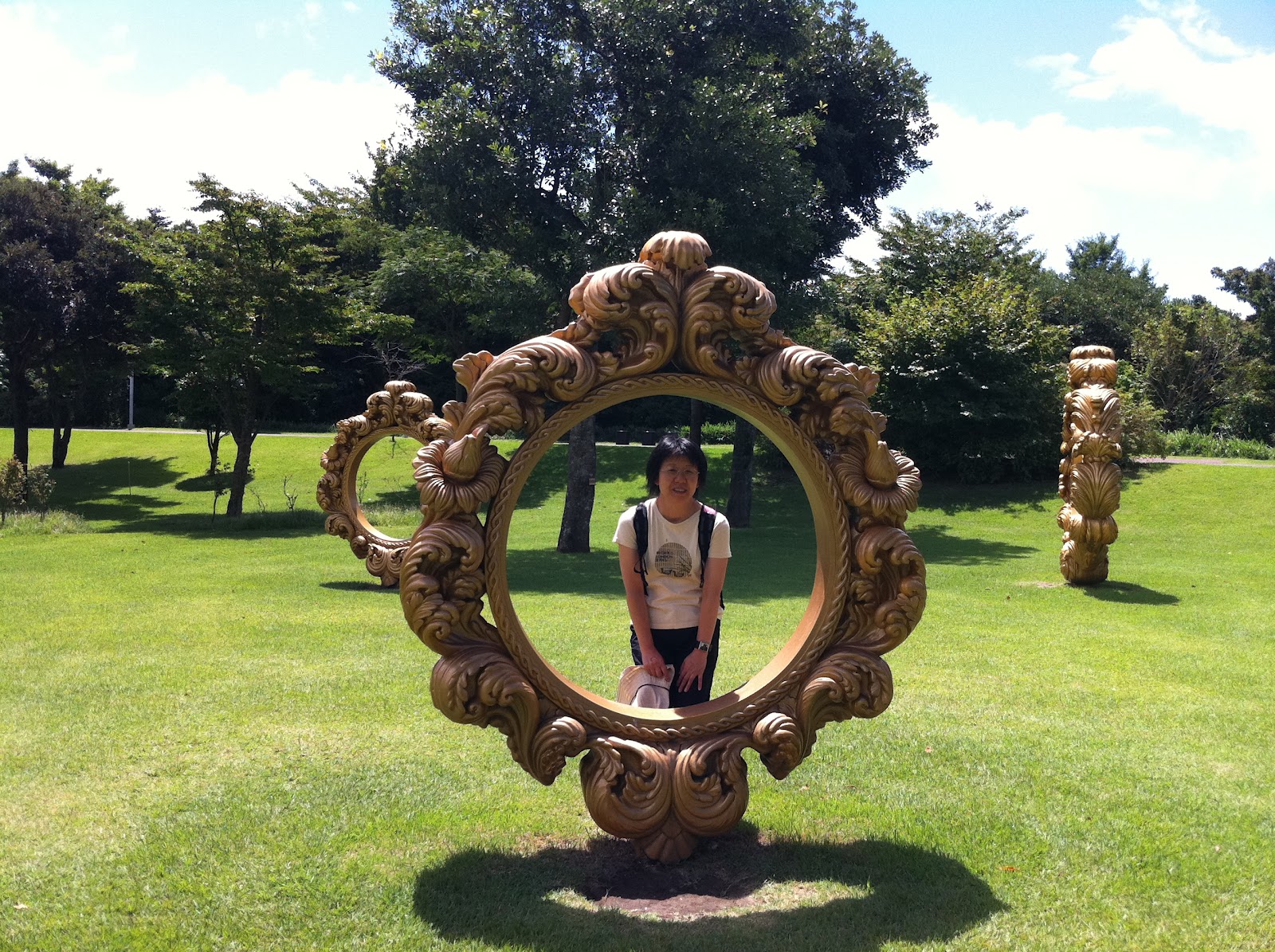
I wanted to check this place out because works by KUSAMA Yayoi, Richard LONG, MIYAJIMA Tatsuo, AOKI Noe, ONO Yoko, Isamu NOGUCHI, etc. are displayed there. And it's good to go to highlands in summer for cooling down. 


Seems to be an ideal location for taking your children. The nature is beautiful and kids can play in the unaffected yet artistic atmosphere.


Not just one. They stand in a forest.

You are special !


Tuesday, September 6, 2011

Aso is accessible by train and bus

If you love to travel by train, Kyushu is one good destination that you can enjoy attractive trains. 


Aso is accessible by taking a train at Kumamoto Station. Some of the trains go straight to Aso without transfer; many others need transfer at Higo-otsu but on the same platform. Roughly takes 1.5 hours and costs 1080 yen. Not bad. There's a charming limited express called Kyushu Odan Tokkyu, meaning the Trans-Kyushu Limited Express. Taking 1hour and 13 minutes, the train takes you from Kumamoto to Aso. For this you need extra 900 yen.


There should be bus services taking you to higher places of Mt. Aso. I loved staying at a pension located higher up. Very refreshing. 


Instead of getting off at Aso, you can try Miyaji, six-min-train ride away from Aso. Walk 15 to 20 minutes from the station and you are arriving at Aso Shrine and its neighborhood. Water is good here as is often the case in many parts of Kumamoto. 


Aso Shrine must have originated from mountain worship in ancient times. People felt awesome about explosive Mt. Aso, which has been harsh and generous at the same time. That's how mother nature should be in this country and you naturally feel humble when embraced by this type of surroundings. 


The approach to the shrine does not lead perpendicularly to the shrine buildings but in parallel with the lined up halls. The approach rather looks like leading to Mt. Aso and you will be impressed by the mountain seen from the precincts.


Local kids are often around the shrine, making the area friendly and peaceful. 


On the premises stand some interesting objects such as a wishing stone (you rub it and make a wish), a love pine tree (you and your significant other go around the tree in opposite directions; when you meet you two pray for your eternal love; young couples feel like kissing there), and a scale you can take a measurement of your child's height (my fun loving guests pretended that their mug shots were taken; very funny).


Aso's drinking water and bathing water are both good. You will be cleansed from inside and outside. Good deal, isn't it?


See the water welling from Shirakawa Suigen fountainhead

Fortunately I recovered a video clip I took when I went to the fountainhead in Minami Aso. Here it is. Enjoy the blessing from Mother Nature. Also see the blog article about this fountainhead I wrote several articles back for more info.


Aso's kawaii mountain: Komeduka


Kawaii meaning pretty in Japanese represents a significant part of Japanese pop culture. 


This is a KAWAII mountain in the Aso Caldera, Kumamoto Prefecture. Iron fences block the approach to the mountain and that's the nearest point you can go. You are not allowed to climb it due to protection of its vegetation. 

It's one of the landmarks of Aso and impossible to miss. Its top is concave as if Aso God had scooped rice grains from a heap of the harvest and generously given it to the poor.


The mountain worship must be one of the oldest forms of Japanese faith systems. Naturally people feel awesome, looking the grand Aso Mountains and alike. Nearby Kirishima Mountains also have many celestial mythological stories.


The surrounding area is beautifully grassy. In fall, there must be a lot of silver grass dancing in the wind.


Aso is beautiful in every season. Now that we've found a place where we can stay with our cat, we'll be back in different times of the year to appreciate the changing seasons and the circle of life.